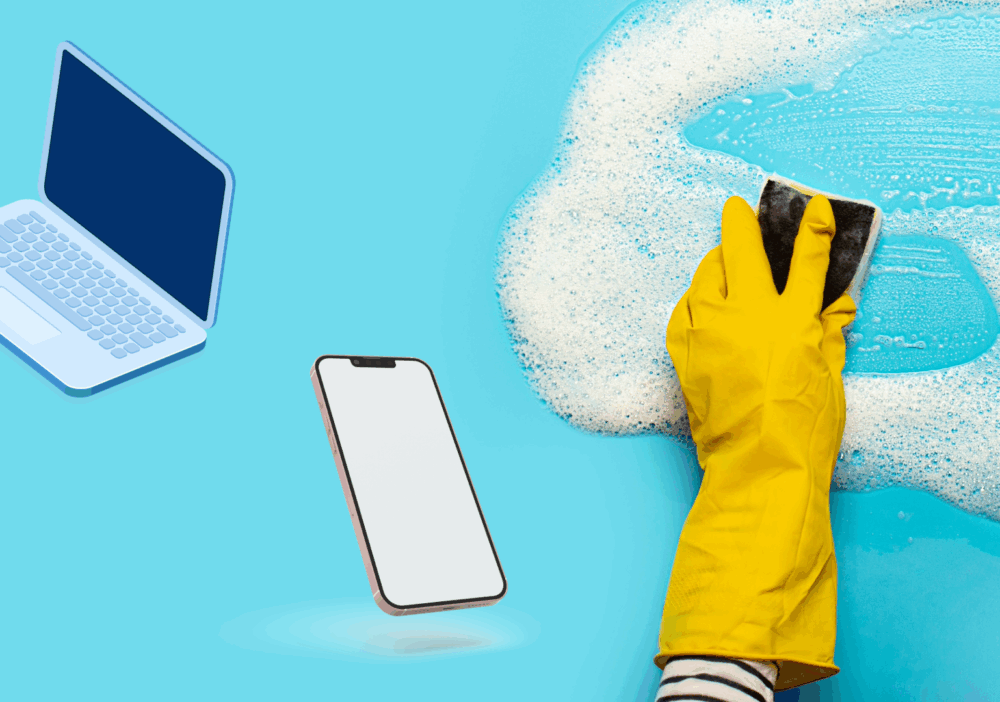
Most of us will spend at least some time every year to have a deep spring clean of our house. We may also check our windows and door locks to make sure our houses are secure, as well as general maintenance so that our houses are well maintained.
But we should also apply the same attention to our digital lives. You could be leaving yourself and your personal data at risk or exposing yourself to cyber threats, various online harms and even fraud.
Whatever the time of year, it’s always a good time to have a digital spring clean.
Uninstall Unused Apps
Have you found yourself with so many apps on your phone, that you find it difficult to find the one you want? That’s probably a sign that you’ve got too many. Take some time to uninstall some apps that you haven’t used for a long time, and are unlikely to use in the near future. Leaving unused apps on your device not only takes up storage space on your device, but it could also potentially leave your personal data at risk.
Update Your Apps
Now that you have uninstalled your unused apps, your next step is to update your apps. By default, your apps should be automatically updating, but it is always a good idea to manually check. Both iPhone and Android have guides here and here on how to check if apps have updated. Software installed on laptops and desktops usually have its own method of updating, so check with the software vendor on how to update theirs.
Update Your OS
Another important step in protecting yourself is to update your Operating System (OS). OSes update automatically, but there are manual ways of checking and updating. Here are the most popular OSes on how to manually update:
Close Unused Accounts
Have you ever found yourself creating account after account for various online services? You are not alone. If you have stopped using an app or an online service or you haven’t shopped at an e-commerce store for some time, it may be time to close your account. When you close your account, the business or service should delete all of your data. Closing your account reduces your risk of having your personal data compromised, mishandled or exposed.
Changing your Passwords
While you are checking accounts to close, why not change your passwords for accounts that you are keeping? Changing passwords protects your personal data in case your email address and passwords have been exposed to online fraudsters. Remember – if an online fraudster has your email address and password from a data leak, and you use the same email address and password combination for other websites, they will use the same combination to log in to other accounts. Changing your password is simple … start by reading our advice.
If you are pushed for time, check to see if any of your accounts have been compromised by entering your email address into www.haveibeenpwned.com. If your email address has appeared in any data leaks, change those passwords in all accounts that use that email address.
Enable 2FA
Two Factor Authentication, or 2FA, is an added layer of account security. When you log in to your account, you will either get an SMS, an email or a notification through your Authenticator app to double check it is actually you that is logging in. A lot of services – including banking and office apps – either make 2FA mandatory or highly recommend that you enable it. In any case, if a service allows 2FA, adopt it. It is an extremely effective way of blocking online fraudsters.
You’re all done…for now
Carrying out the above tasks is a good step to take to improve your online safety. It’s also a good idea to do it from time to time. Set aside half an hour every 3 – 6 months if you can.
Remember, we have a collection of self help tools that are free to use, including our Check A Website tool that can tell you if a website is fake or a scam before you visit it.